The numbers behind the game
American Sports Facts, Stats and Rules: Field Sizes and Player Numbers
Data as of October 2026

-
NFL
360 × 160 ft
Full football field
-
NBA
10 ft
Rim height
-
MLB
60 ft 6 in
Pitching distance
American sports run on numbers that almost never change. A football field is 360 feet long, an NBA rim hangs 10 feet above the floor, and the pitcher's plate sits 60 feet, 6 inches from home plate. This page collects American sports facts, stats and rules for football, basketball and baseball in one place, with each figure tied to the published rulebook or league page it comes from. The sections below explain what the numbers mean, how they compare across the three sports, and which pages on this site answer the most common questions in detail.
American sports facts start with the playing surface
Every sport begins with a rectangle, a court or a diamond, and the dimensions of that space decide almost everything else: how fast the ball travels between players, how many people can fit on the surface, and how a fan in the last row experiences the game. The three big American sports use three very different scales, and comparing them is the quickest way to get a feel for the numbers.
-
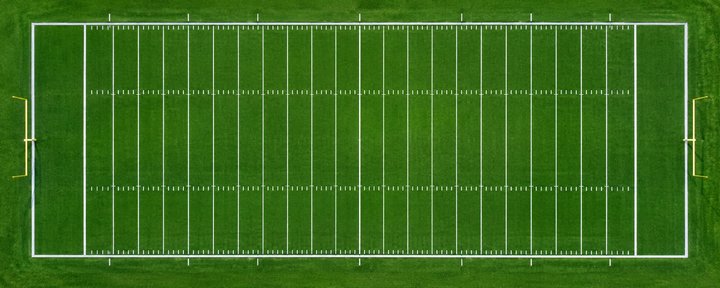
AI-generated image Football
360 × 160 ft
-
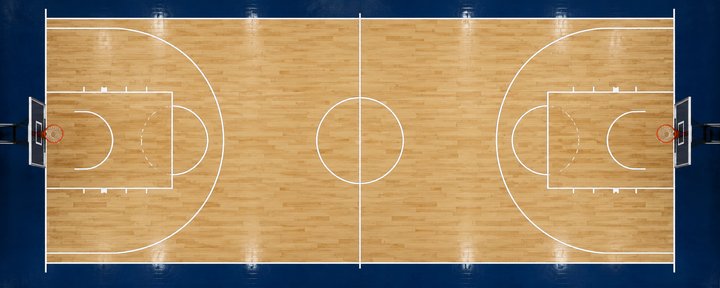
AI-generated image Basketball
94 × 50 ft
-

AI-generated image Baseball
90-ft infield sides
Illustrative photos, not drawn to scale.
An American football field is 360 feet long and 160 feet wide, according to Rule 1 of the NFL rulebook. That is 120 yards by 53 and a third yards, and it covers 57,600 square feet, which works out to roughly 1.3 acres. The goal lines sit 10 yards inside each end line, so the stretch players call the field of play, from goal line to goal line, is 100 yards. A basketball court in the NBA is 94 feet long and 50 feet wide, or 4,700 square feet. Put the two side by side and a football field is about twelve times the size of a basketball court.
Baseball breaks the pattern. A baseball field is not a rectangle, and the rules define the infield most exactly: a 90-foot square. Fence distances in the outfield differ from ballpark to ballpark, which is why a fly ball that is a routine out in one stadium can leave the park in another. The rules also fix the distance from the pitcher's plate to home plate at 60 feet, 6 inches. That figure is one of the few in sports that fans quote to the half foot.
Units cause more confusion than the numbers themselves. Football measures the field in yards because the game is played and broadcast in yards, but the rulebook states the overall field size in feet. Basketball uses feet and inches throughout, from the court to the rim to the three-point arc. Baseball uses feet for the diamond and inches for details such as the height of the mound. Anyone who searches for the size of a field or a court and gets two different answers has usually run into a unit mismatch, not a disagreement. Converting everything to feet first removes most of the confusion.
The measurements also explain why some questions never go out of date. The dimensions in the rulebooks are stable, and the rim has hung 10 feet above the floor for as long as the game has been played. Questions about the size of a field, the height of a rim or the length of a pitching distance are among the most stable American sports facts, which is why they work well as a starting point for anyone new to the games.
01/NFL
American football rules and numbers: field, clock and season
The NFL rulebook describes the field in plain terms. The game is played on a rectangular field 360 feet in length and 160 feet in width. The lines at each end are the end lines, the lines on each side are the sidelines, and the goal lines are established 10 yards from and parallel to each end line. The area between the goal lines and the sidelines is the field of play, and the areas behind the goal lines are the end zones. A pair of lines parallel to each sideline, 70 feet, 9 inches inbounds, marks the inbounds lines, which is where the hash marks sit.
Those few sentences contain most of what people ask about the size of a football field. The 100 yards between the goal lines is the length that matters for play, the 10-yard end zones bring the total to 120 yards, and the width of 160 feet is 53 and a third yards. Whether a question refers to the field of play or to the full field changes the answer, and so does the way acres are counted. The page on how many acres a football field covers walks through each version of the calculation, and the page on the full dimensions of a football field covers the markings, the hash marks and the end zones in detail.
The league itself is built from 32 teams, split evenly between the American Football Conference and the National Football Conference with 16 teams in each. The regular season is 17 games per team spread over 18 weeks, which leaves every team one bye week. Because every game involves two teams, 32 teams playing 17 games each produce a schedule of 272 games. Compared with basketball and baseball, that is a very short season, and it explains why a single game carries so much weight in the standings.
Short seasons also shape American sports stats in football. Totals for a player over a season are built from 17 games at most, so a single big game moves a season average much further than it would in baseball. Pages on this site that deal with football stats say whether a figure is a season total, a per-game average or a career figure, because the three are easy to mix up. Readers who want the scoring side of the sport can start with the page on the most common NFL scores, which explains why certain final scores appear far more often than others.
Player numbers are the other popular subject. The size of the people on the field matters to fans who wonder whether they could ever play, and the page on the average height of an NFL player breaks the figure down by position, since a kicker and an offensive lineman have almost nothing in common physically. Related pages cover other figures about the people and the places:
- Average weight of NFL players
- Career length of an NFL player
- NFL stadiums with domes, for fans who care about where the games are played
- The NFL hub, where everything about the league is collected
02/NBA
Basketball stats and rules: court, rim and schedule
The NBA describes its own court in one sentence: the rims hang 10 feet from the floor, at opposite ends of a court that is 50 feet wide and 94 feet long. Rule 1 of the official rulebook adds the details that matter for shooting. The upper edge of each ring is 10 feet above and parallel to the floor, and the ring has an inside diameter of 18 inches. The three-point line is an arc of 23 feet, 9 inches from the middle of the basket, joined to two straight lines 3 feet from the sidelines that run out from the baseline.
Nothing in that description has moved in the modern game, which makes the rim height one of the most reliable numbers in sports. The question of how tall a rim is comes up constantly, partly because people want to know whether they could dunk, and partly because hoops at parks and gyms are often adjustable. The page on the height of NBA rims covers the official figure, the way it is measured, and what changes at lower levels of play. The related page on basketball air pressure covers the ball itself.
The league has 30 teams in two conferences, with three divisions in each conference. Each team plays 82 regular-season games. With 30 teams each playing 82 games, the schedule contains 1,230 games, because every game counts for two teams. That is more than four times the length of an NFL schedule for each team, and it changes how statistics behave. A shooting streak over ten games means little across 82, and a player who misses a month to injury can still finish the year with respectable totals.
The length of the season is a regular source of questions, since the schedule stretches across the autumn, winter and spring before the playoffs begin. The page on how long the basketball season lasts lays out the stages, from the opening night through the regular season and into the playoffs. The rules are the other frequent topic, and the page on what PF means in basketball explains personal fouls and the limit that sends a player out of the game.
Traveling is the rule fans argue about most. The page on how many steps you can take in basketball sets out the gather, the two-step limit and the pivot foot as the rulebook words them, and the page on NBA rim height covers the basket itself. These American sports stats and rules are easy to misread without the exact wording. The full set of pages sits on the NBA hub.
03/MLB
Baseball rules and stats: the diamond and a 162-game season

- 90 ftInfield square side
- 60 ft 6 inPitching distance
- 162Games / team
Baseball is the sport where the rulebook is most specific about distances that look arbitrary. The infield is a 90-foot square. The distance between the pitcher's plate and the rear point of home plate is 60 feet, 6 inches, a figure that has stood since 1893, when the mound was moved back from 50 feet. The pitcher's plate is a slab of whitened rubber 24 inches by 6 inches, and it sits 10 inches above the level of home plate. The rules define the height of the mound as precisely as the size of the plate.
The season is the opposite of football's. Each of the 30 teams plays 162 regular-season games, which makes the full schedule 2,430 games. A season stretches from spring into the fall and is long enough that luck mostly evens out, which is why baseball statistics reward long-run analysis. A batter's average over 20 games can be misleading, while the same average over 162 games says something real about the player.
For beginners the vocabulary is the hardest part. Terms such as the designated hitter or a fielder's choice show up in box scores long before anyone explains them. Baseball pages are being added to the MLB hub, which collects everything on the sport as it is published.
Comparing the three seasons shows how different the sports are. A football team plays 17 games, a basketball team plays 82 and a baseball team plays 162. Roughly speaking, each sport multiplies the number of games by a factor of five or two, and the consequences run through everything from the way players are rotated to the way fans follow the standings. A loss in football is about six percent of a team's regular season. A loss in baseball is less than one percent of it.
One season. Three different scales.
Regular-season games per team
- 17NFL
- 82NBA
- 162MLB
How the numbers are checked and dated
Rules and dimensions come from the published rulebooks and the official league pages, and every figure on this page can be traced to one of them:
- The NFL figures come from Rule 1 of the official NFL playing rules.
- The basketball figures come from Rule No. 1 of the NBA rulebook.
- The league's own overview page gives the basketball season and team figures.
- The baseball figures come from the field dimensions entry in the MLB rules glossary.
When two official pages disagree, the rulebook counts as the authority. Disagreements do happen: a league's general overview page and its rulebook can give different numbers for the same quantity, and the rulebook is the document that officials actually use. Where a conflict is relevant to a page, the page says which figure it follows and why.
Some numbers on this site are calculated rather than quoted. Areas, game totals and unit conversions are arithmetic on published figures, and they are written so that anyone can repeat them: 360 feet multiplied by 160 feet gives 57,600 square feet, and 30 teams playing 82 games each, divided by two because every game involves two teams, gives 1,230 games. Averages such as player height or career length are different. A single official source for them does not exist, so a page that gives an average names the study it comes from, or explains the dataset and the method used to calculate it, and gives the date.
Figures that change over time carry the month and year they were last checked. The team counts and schedule lengths on this page are current as of October 2026. Pages with salaries, ticket prices or stadium lists show their own date and are reviewed once a year. If no reliable source exists for a number, the page says what is known and what is not, instead of filling the gap with an estimate.
Where to start: the most searched American sports questions
Most visitors arrive with one specific question, and the quickest way through the site is by sport. The football pages cover the size and shape of the field, the most common final scores, and the physical profile of the players. The basketball pages cover the rim, the ball, the length of the season and the length of a career. The baseball pages cover the diamond, the equipment and the vocabulary.
A few questions come up more than any others. People want to know how big a football field is in acres, because the comparison is the standard way to describe the size of a park, a farm or a building lot. They want to know the most common scores in the NFL, how tall a basketball rim is and how much air a basketball needs. They want to know how tall a player has to be to make a professional league, and how many years a professional career actually lasts. The pages behind those questions are linked from the sport hubs above, and each begins with the short answer before moving on to the detail.
Newcomers to American sports often find the structure of the leagues harder than the rules. The NFL, the NBA and MLB all use conferences or leagues and divisions, but the details differ, and the playoffs work differently in each. The hubs explain the structure of each league in a few paragraphs, with links to the individual team and rules pages. Readers who already follow one sport can use them to see how the same question is answered in the other two.
The aim of the whole collection is to keep the answers short, the sources visible and the numbers current. Reading the three hubs in order gives a working picture of American sports facts, stats and rules in an afternoon, and the individual pages give the detail whenever a specific figure is needed.
Football
- How many acres a football field covers
- Full dimensions of a football field
- Most common NFL scores
- Average height of an NFL player
- NFL stadiums with domes
- Average lifespan of an NFL player
- Can NFL games end in a tie?
- When the clock stops out of bounds
- Is a blocked field goal a live ball?
- What the C patch means
- Most sacks in a game
- Does a quarterback have to say hike?
- Can a punt become a field goal?
- What position is edge
- Are NFL games rigged?
American sports facts and stats: common questions
What are the most useful American sports facts for a beginner?
Start with the three sizes that anchor the games: a football field is 360 feet by 160 feet, an NBA court is 94 feet by 50 feet with the rim at 10 feet, and a baseball infield is a 90-foot square with the pitching distance at 60 feet, 6 inches. Add the season lengths of 17, 82 and 162 games, and most of the other numbers fall into place.
How many games are in a season in the NFL, NBA and MLB?
Each NFL team plays 17 regular-season games, each NBA team plays 82 and each MLB team plays 162. These figures are current as of October 2026.
Where do the American sports stats on this site come from?
Rules and dimensions come from the official rulebooks of each league. Averages come from a named published study or from a calculation whose method is shown on the page, and every figure that changes carries the month and year it was last checked.
How big is a football field in feet and yards?
The full field is 360 feet by 160 feet, which is 120 yards by 53 and a third yards. The field of play between the goal lines is 100 yards long, and each end zone adds another 10 yards.
How high is a basketball rim?
The upper edge of the ring is 10 feet above the floor, and the ring has an inside diameter of 18 inches, according to Rule 1 of the NBA rulebook.
How far is the pitcher from home plate?
The distance from the pitcher's plate to the rear point of home plate is 60 feet, 6 inches, and the plate sits 10 inches above the level of home plate.
Do these American sports rules change from year to year?
Dimensions rarely change, but rules about play, schedules and team counts can change between seasons. Pages note the month and year of the last check so a reader can see how current a figure is.